
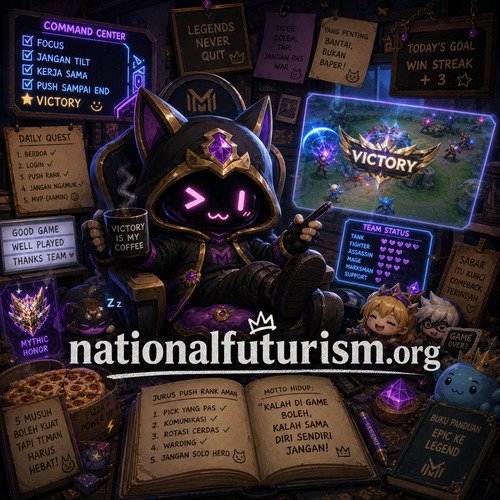
nationalfuturism.org – Mobile Legends: Bang Bang is a fast-paced multiplayer online battle arena game where individual mechanical skill matters, but good decision-making often determines how effectively a team can control the match. A player may have excellent reflexes and still struggle if they do not understand lane management, map awareness, objectives, positioning, or the responsibilities of their chosen role. Learning how to play Mobile Legends therefore involves much more than memorizing hero abilities or trying to secure as many eliminations as possible. The game constantly asks players to make decisions about where to move, when to fight, when to retreat, and which objective deserves attention at a particular moment.
For beginners, the large number of heroes, items, roles, abilities, and tactical possibilities can initially make the game seem complicated. However, the basic structure becomes easier to understand once the match is viewed as a sequence of connected decisions. Players begin in their respective areas, collect experience and gold, contest lanes and jungle resources, and gradually work toward controlling important parts of the battlefield. As the match develops, towers become increasingly important, team fights become more consequential, and objectives such as the Turtle and Lord can dramatically change the flow of the game. Understanding these relationships allows players to approach each match with a clearer purpose rather than simply reacting to whatever happens on screen.
Understanding the Core Gameplay of Mobile Legends
One of the first things a Mobile Legends player should understand is the purpose of each role. Different heroes are designed to contribute in different ways, and a team becomes much easier to coordinate when every player understands what their selected role is expected to accomplish. The common roles include Tank, Fighter, Assassin, Mage, Marksman, and Support, although individual heroes can sometimes perform functions that overlap between categories. A Tank generally provides durability, crowd control, and protection, while a Fighter combines offensive pressure with survivability. Assassins usually rely on mobility and burst damage to eliminate vulnerable targets, whereas Mages often contribute magical damage, zoning abilities, or crowd control. Marksmen generally become increasingly valuable as they gain items and provide sustained ranged damage, while Supports help allies through healing, shielding, crowd control, vision-related pressure, or utility.
Choosing a role should not mean focusing exclusively on one task throughout the entire match. A Marksman, for example, should farm efficiently during the early stages but also recognize when an objective fight requires their presence. A Tank may initiate an engagement, but that does not mean charging forward whenever an enemy appears. A Jungler has access to important resources and can influence lanes, yet invading the opposing jungle without considering enemy positions can create unnecessary risks. Understanding the broader purpose of each role makes gameplay more deliberate. Instead of asking only whether a player can defeat an opponent, it becomes more useful to ask whether an action improves the team’s position. Securing a tower, protecting a teammate, forcing an enemy to retreat, or creating space around an objective can all be valuable even when no elimination occurs.
Building a Strong Early-Game Routine
The opening phase of a Mobile Legends match establishes the foundation for everything that follows. Players should focus on collecting resources efficiently while avoiding unnecessary deaths. Gold provides access to items, experience unlocks and improves abilities, and lane pressure can determine which team gains access to important areas of the map. A common mistake among inexperienced players is treating the early game as an opportunity to constantly chase opponents. This can cause missed minions, poor positioning, and unnecessary exposure to enemy attacks. A more controlled approach involves understanding when to trade damage, when to clear a wave, and when to move away from danger.
Minion waves deserve particular attention because they create pressure against enemy structures and provide resources to nearby players. Clearing a wave does not always mean immediately pushing as far as possible. Players can sometimes benefit from controlling the position of the wave so that they remain in a safer location while still gaining gold and experience. When an opponent leaves the lane, the decision becomes more complicated: pushing may allow a tower to take damage, while rotating may create an opportunity elsewhere. The correct choice depends on the location of teammates, enemy heroes, objectives, and the current state of the map.
The early game is also when players should develop the habit of checking the minimap. Looking at the map regularly provides information that cannot be obtained by watching the character alone. If several enemies disappear simultaneously, a player should consider whether a rotation is occurring. If an ally is being pressured on another side of the map, there may be an opportunity to respond. These observations help transform gameplay from a series of isolated lane battles into a broader tactical process.
Managing Resources Without Taking Unnecessary Risks
Gold, experience, health, mana or energy, cooldowns, and positioning are all resources. Strong gameplay comes from recognizing that these resources influence one another. A player with low health may technically have all of their abilities available, but engaging an enemy can still be dangerous. Similarly, a hero with ultimate ability available may be powerful, but using it against a low-value target could leave the team without an important tool during the next objective fight.
Efficient resource management also applies to movement. Walking across the map without a clear purpose can waste valuable time, especially when another lane needs assistance or a neutral objective is approaching. Players should develop a habit of moving with intention. Before rotating, they can consider what they are trying to accomplish and what they will do if the situation changes. This does not require predicting everything perfectly. Instead, it encourages players to avoid automatic movement and think about the relationship between time, position, and opportunity.
Developing Better Map Awareness and Teamfight Decisions
The minimap is one of the most important sources of information in Mobile Legends. Players who rarely look at it often react too late to enemy rotations, ambushes, and objective contests. By contrast, frequent map checks can reveal patterns even when enemies are not directly visible. If an opposing hero disappears from a lane, the player should consider possible destinations rather than assuming the enemy has simply returned to base. If multiple opponents are missing, the possibility of an attack or objective attempt becomes more important.
Map awareness also involves understanding what information is currently available and what information is missing. When several enemy heroes are visible on one side of the map, the opposite side may temporarily offer more freedom for farming or pushing. However, this advantage can disappear quickly if enemies rotate. Good players therefore avoid assuming that an area is safe merely because nobody is visible at the moment. They combine recent information with the likely movement patterns of the opposing team.
Vision and positioning are especially important around jungle entrances and objectives. Entering an unfamiliar area alone can be dangerous because enemies may be waiting outside direct vision. A safer approach is to move with teammates or approach from a position that provides more information. This principle is useful across all roles. Even heroes with strong mobility should not treat mobility as a replacement for awareness. Escape tools are most effective when the player understands the danger before the situation becomes impossible to control.
Knowing When to Fight and When to Retreat
Team fights are often decided before the first major ability is even used. Positioning, cooldown availability, health levels, and the location of important damage dealers can determine whether an engagement is favorable. A player should not automatically enter every fight simply because an enemy is nearby. Sometimes the better decision is to wait, reposition, or allow the opposing team to move into a less favorable location.
Initiation should also have a purpose. Tanks and Fighters may begin engagements by using crowd control, but an initiation becomes less useful if teammates cannot follow. Conversely, a damage dealer who moves too far forward may become the first target and lose the ability to contribute. Each hero needs to understand their effective range and the threats that can reach them. Marksmen generally want to maintain distance while dealing sustained damage, Mages often seek advantageous angles for abilities, and Assassins may wait until important enemy defensive tools have been used.
Retreating should not be viewed as failure. A controlled retreat can preserve health, prevent unnecessary deaths, and create another opportunity later. If an objective has already been secured or the enemy team has gained a positional advantage, continuing to fight may provide little benefit. Experienced gameplay often involves recognizing when the original plan is no longer appropriate and changing direction quickly.
Turning Objectives Into Team Advantages
Eliminations can create opportunities, but objectives are what convert many advantages into lasting map control. Towers restrict movement and protect important areas, while major neutral objectives can provide significant strategic benefits. The Turtle is particularly relevant during the earlier stages of a match, while the Lord becomes increasingly important as teams look for ways to pressure enemy defenses and end the game.
Objective preparation should begin before the objective actually appears as the main point of conflict. Players can clear nearby waves, recall to restore resources, position around entrances, and monitor enemy movement. Arriving at an objective with low health and incomplete resources creates a weaker position than arriving prepared. Similarly, starting an objective while several enemies are missing can be dangerous because the opposing team may be approaching from an unexpected direction.
Objective control also requires communication. Players should understand whether the goal is to secure the objective, force enemies away, or simply establish control of the surrounding area. Sometimes starting the objective immediately is unnecessary. Holding a favorable position can force opponents to reveal themselves first. This creates more information and can make the eventual engagement easier to manage.
Practicing Hero Mechanics With Purpose
Mechanical skill is an important part of Mobile Legends, especially for heroes with complex abilities or demanding movement patterns. However, practicing combinations without understanding when to use them can produce limited improvement. Players should connect mechanical practice with actual match situations. Instead of memorizing an ability sequence mechanically, they should understand what the sequence is supposed to accomplish.
For example, a combo may be designed to burst down a fragile target, initiate crowd control, escape from danger, or reposition during a fight. Each purpose creates different requirements. A player who understands those requirements can adjust the sequence when the enemy reacts. This flexibility is more useful than attempting to reproduce exactly the same pattern in every situation.
Players should also become familiar with their hero’s limitations. Understanding maximum effective range, cooldown windows, damage patterns, defensive tools, and vulnerable moments helps prevent overconfidence. A hero may have impressive damage but remain vulnerable when key abilities are unavailable. Recognizing this timing creates opportunities to play aggressively when appropriate and defensively when necessary.
Improving Through Match Review and Adaptation
Improvement does not come only from playing more matches. Players can learn significantly by examining why particular situations went wrong. After a difficult match, it can be useful to consider whether deaths occurred because of poor positioning, lack of map awareness, an unfavorable fight, missed resources, or an incorrect objective decision. Identifying a specific problem makes future practice more focused.
For example, if a player repeatedly dies while pushing a side lane, the problem may not be their hero’s damage output. They may be pushing without information about enemy locations. The solution would therefore involve better map awareness rather than simply changing items. Similarly, if a player consistently loses team fights despite dealing high damage, positioning or target selection might deserve attention.
Adaptation is particularly important because opponents do not always follow the expected pattern. A strategy that works against one team may fail against another. Players should therefore avoid treating guides or previously successful matches as fixed formulas. Instead, they can use general principles and adapt them according to the current game state.
Developing Team-Oriented Communication
Mobile Legends is a team game, so communication can have a significant effect on coordination. Communication does not necessarily require long messages or complicated instructions. Simple information about missing enemies, objective timing, retreating, or initiating a fight can help teammates understand the situation.
Players should also recognize that communication is most useful when it provides actionable information. Repeatedly blaming teammates rarely improves coordination. A clearer approach is to focus on what the team can do next. If a fight is lost, the next priority may be defending a tower, clearing waves, preparing for an objective, or preventing another enemy push.
Team-oriented thinking also means understanding that every player will make mistakes. Rather than allowing one poor decision to dictate the rest of the match, teams can reset their positioning and focus on the next available opportunity. Maintaining attention on the game state helps prevent emotional reactions from creating additional problems.
Conclusion Mastering Mobile Legends: A Complete Guide to Smarter Gameplay, Teamwork, and Winning Habits
Learning how to play Mobile Legends effectively is a gradual process that combines mechanical control, map awareness, resource management, objective planning, positioning, and teamwork. Beginners can start by understanding the responsibilities of each role, developing a reliable early-game routine, and learning to use the minimap as a constant source of information. As their experience grows, they can focus more heavily on timing, rotations, teamfight positioning, and objective preparation.
The most useful mindset is to treat every action as part of a larger strategy. Farming creates resources, resources create item advantages, item advantages influence fights, successful fights create opportunities for objectives, and objectives create pressure against enemy structures. When players understand these connections, matches become easier to read and individual decisions become more meaningful. Improvement ultimately comes from combining practice with reflection: learning hero mechanics, observing mistakes, adjusting decisions, and gradually becoming more aware of what the team needs at each stage of the match.