
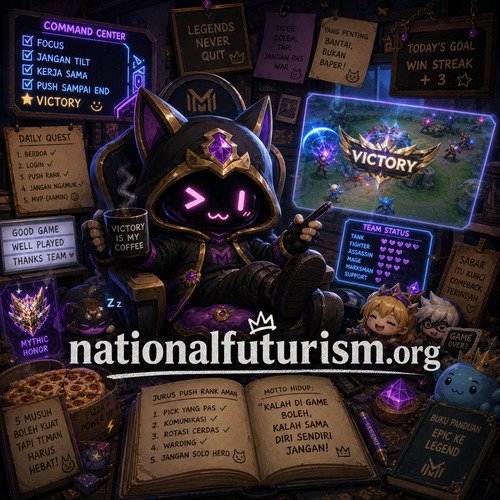
nationalfuturism.org – Mobile Legends: Bang Bang has become one of the most popular competitive mobile games in the world. The game is especially well known in Southeast Asia, where it has built a strong esports community and a massive player base. Many players start because the game is easy to access on a smartphone, but they continue playing because the strategic depth makes every match feel different and challenging.
The design of Mobile Legends is simple enough for beginners to understand quickly. Players choose one hero, enter a five-versus-five match, and attempt to destroy the enemy base. However, once someone spends more time in the game, they begin to understand that there is far more to success than simply defeating enemies. Strong performance requires understanding hero roles, objective timing, farming, map awareness, and team coordination.
What makes the game so engaging is the constant balance between action and planning. Some moments require quick reflexes, while others depend on patience and strategic judgment. This combination creates a competitive environment that rewards players who are willing to learn and adapt.
The Main Elements That Define Mobile Legends
The most important thing to remember in Mobile Legends is that victory comes from destroying the enemy’s base crystal. Everything else in the game supports that goal.
The battlefield is divided into three lanes. Each lane has several defensive towers that protect the path to the base. To win, a team must push minion waves, destroy these towers, and eventually reach the enemy core.
Many players focus too heavily on kills because combat is the most visible part of the game. However, kills are only useful if they create opportunities to secure objectives. A team can dominate in eliminations and still lose if it does not take towers or pressure the map.
Experienced players understand that every action should contribute to the main objective. Winning a fight should lead to a push, an objective capture, or a stronger map position.
The Importance of Hero Roles
Every hero in Mobile Legends has a role, and these roles shape how a team functions. The main categories are Tank, Fighter, Assassin, Mage, Marksman, and Support.
Tanks serve as the defensive front line. They absorb damage and protect more fragile allies. Fighters are durable offensive heroes who can perform well in close combat.
Assassins are fast heroes designed to eliminate vulnerable targets quickly. Mages deal magical burst damage and often control team fights through crowd control. Marksmen provide sustained ranged damage and usually become strongest in the late game. Supports assist teammates through healing, shields, or utility.
A balanced team composition gives a much better chance of success. Without a tank, damage dealers may be exposed. Without a marksman, the team may lack late-game damage.
Learning each role also improves overall understanding. A player who knows how assassins operate, for example, will better understand how to avoid them when playing a marksman.
Farming and Economic Advantage
Gold and experience are the resources that determine hero strength. Players gain these by defeating minions, jungle monsters, and neutral objectives.
Farming is the process of collecting these resources efficiently. It may seem less exciting than fighting, but it is one of the most important skills in the game.
A player who farms well can buy items faster, making their hero significantly stronger. Even a few extra minutes of efficient farming can create a major advantage.
Jungle camps provide additional resources, and buffs play an important role in performance. Red buff increases offensive pressure, while blue buff supports heroes who rely on mana or cooldown reduction.
Teams that control resources usually gain a consistent advantage over time.
Playing Through Each Stage of the Match
The early game covers the first few minutes of the match and sets the pace for what follows. During this phase, players should focus on safe farming and lane control.
Lane players must clear minion waves while maintaining good positioning. Moving too far forward without information often leads to easy deaths.
Junglers are very influential in the early game. They secure buffs, clear camps, and rotate to assist teammates. A successful early gank can create momentum across the map.
The first Turtle is usually the most important objective in this phase. Securing it grants extra gold and helps the team progress faster.
A strong early game usually comes from discipline. Avoiding unnecessary mistakes often creates more value than risky aggression.
Mid Game: Map Control and Rotations
Once players have acquired several items and some outer towers have fallen, the match enters the mid game. This stage emphasizes rotations and strategic movement.
Rotations allow players to assist teammates, pressure objectives, and respond to enemy actions. Mid-lane heroes often rotate first because they can move quickly to either side lane.
Teams that dominate the mid game often destroy more towers and invade the enemy jungle. This limits enemy resources and increases map control.
Lord becomes a central objective during this phase. Capturing Lord forces the enemy team to defend and often creates opportunities to break through their structures.
Players who pay attention to the minimap and enemy positions usually make better decisions during this stage.
Late Game: The Deciding Moment
The late game is the most intense phase of Mobile Legends. Most heroes are close to full build, and one mistake can decide the entire match.
Death timers are long, so losing one major team fight often means losing the game.
Positioning becomes the most important skill. Marksmen and mages need to stay protected behind the frontline. Tanks must create space and absorb enemy abilities. Assassins need patience to target vulnerable enemies at the right moment.
The Lord often determines the final outcome. A team that secures Lord while winning a team fight usually gains enough pressure to end the game.
Patience and careful decision-making are critical during this stage.
Master a Limited Hero Pool
One of the fastest ways to improve is to focus on a small number of heroes. Trying to learn every hero at once often creates inconsistency.
Specializing in a few heroes helps players understand skill timing, matchups, and itemization more deeply. This leads to stronger performance.
Once these heroes are mastered, expanding to additional roles becomes much easier.
Analyze Mistakes
Improvement requires reflection. Every match offers lessons, whether the result is a win or a loss.
Players should think about their decisions. Did they farm enough? Did they rotate properly? Did they prioritize objectives?
Answering these questions helps identify weaknesses and improve future performance.
Communicate With the Team
Communication is a simple but powerful tool in Mobile Legends. Pings allow players to warn teammates, signal attacks, and call for retreat.
Teams that communicate well often perform better than teams with stronger individual mechanics but poor coordination.
Working together consistently creates more opportunities than playing alone.
Conclusion Mobile Legends: Understanding the Gameplay and Learning How to Win More Matches
Mobile Legends: Bang Bang is a game that combines fast action with strategic depth. It is easy to start, but mastering it requires understanding objectives, hero roles, farming, and teamwork.
Success in Mobile Legends comes from more than quick reflexes. Players who understand the map, manage resources well, and make smart decisions usually perform better over time.
Improvement is a gradual process, but every match offers a chance to learn. By focusing on a few heroes, analyzing mistakes, and communicating effectively, players can become stronger and enjoy the game more deeply.
What keeps Mobile Legends exciting is its unpredictability. Every match creates new challenges, ensuring that players always have opportunities to grow and refine their skills.