
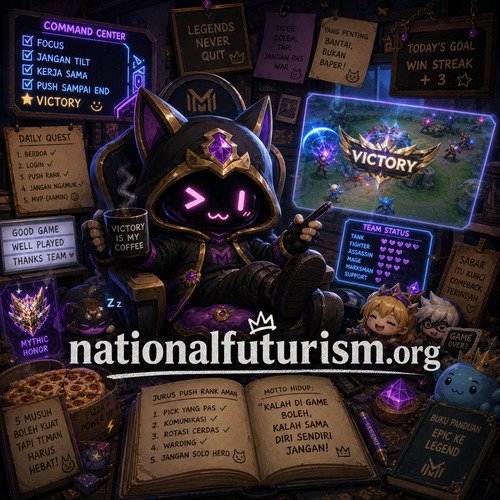
nationalfuturism.org – Mobile Legends continues to stand among the most competitive multiplayer mobile games in the world. Since its rise in popularity, the game has attracted a massive global audience ranging from casual players to professional esports competitors. Every match presents a battlefield where strategic thinking, teamwork, mechanical execution, and adaptability come together to determine the outcome. While many players initially focus on hero skills and flashy plays, long-term success requires a much deeper understanding of the game’s systems.
What makes Mobile Legends unique is the balance between simplicity and complexity. The controls are easy to learn, allowing new players to jump into matches quickly. However, beneath the accessible surface lies a strategic environment filled with decisions that influence every stage of the game. Resource management, map awareness, objective control, hero matchups, and team coordination all play critical roles in achieving victory.
Many players become stuck at certain ranks because they focus only on individual performance. They measure success through kill counts rather than overall impact. In reality, some of the most valuable contributions in Mobile Legends never appear clearly on the scoreboard. Creating map pressure, protecting allies, controlling objectives, and forcing favorable engagements can often influence a match more than securing multiple eliminations.
Understanding how the different elements of Mobile Legends connect with one another is the first step toward becoming a stronger competitor. Players who approach the game strategically are usually more consistent and adaptable, allowing them to perform effectively regardless of hero choice or team composition.
Understanding the Foundations of Successful Gameplay
Before advanced strategies can be applied effectively, players must first develop strong fundamentals. These core concepts form the foundation upon which all high-level gameplay is built.
Every hero in Mobile Legends depends on resources to become stronger. Gold allows players to purchase items, while experience increases hero levels and unlocks stronger abilities. Together, these systems determine a hero’s overall strength throughout a match.
Many inexperienced players underestimate the importance of resource management. They spend too much time chasing opponents or engaging in low-value fights while neglecting farming opportunities. Although eliminations can provide rewards, consistent resource collection is often more reliable and sustainable.
Strong players understand that every minion wave, jungle camp, and objective contributes to long-term progression. They maximize efficiency by minimizing downtime and ensuring that every movement serves a purpose. Over time, these habits create substantial advantages that become increasingly difficult for opponents to overcome.
A hero with superior resources often controls engagements more effectively because stronger items and higher levels provide better damage, durability, and utility.
Developing Consistent Map Awareness
Map awareness is one of the most important skills in Mobile Legends because it affects nearly every decision a player makes. Information gathered from the minimap helps identify threats, opportunities, and strategic priorities.
Elite players constantly monitor the battlefield rather than focusing exclusively on their immediate surroundings. They pay attention to enemy positions, missing heroes, objective timers, and teammate movements. This information allows them to predict potential dangers and respond proactively.
For example, if several enemies disappear from the map simultaneously, there is a strong possibility that a rotation or ambush is being prepared. Recognizing this pattern early allows players to retreat safely or alert teammates. Similarly, observing enemies on one side of the map may create opportunities to secure objectives elsewhere.
Developing strong awareness transforms gameplay from reactive decision-making into proactive strategic control.
Understanding Hero Roles Beyond Their Labels
Many players view hero roles too simplistically. While labels such as tank, fighter, mage, assassin, marksman, and support provide general guidance, understanding each role’s broader responsibilities is essential.
Tanks are responsible for creating space and protecting teammates rather than merely absorbing damage. Fighters often balance pressure, durability, and objective control. Assassins excel at disrupting enemy formations and eliminating key targets.
Mages contribute crowd control, burst damage, and zone management. Marksmen provide sustained damage output, especially during the later stages of the game. Supports strengthen team effectiveness through utility, healing, protection, and strategic assistance.
Recognizing these responsibilities helps players make decisions that align with their role and improve overall team performance.
Building Mid-Game Momentum Through Smart Strategy
The mid game is where strategic decisions begin to have a significant impact. Teams transition from isolated laning phases into coordinated efforts focused on objectives and map control.
One of the most important skills in Mobile Legends is understanding how to convert advantages into meaningful progress. Winning a fight is valuable, but what happens afterward often matters more.
A successful engagement should ideally create opportunities to secure objectives such as turrets, Turtle, Lord, or enemy jungle resources. These rewards provide lasting benefits that continue influencing the match long after the fight has ended.
Teams that fail to capitalize on advantages often allow opponents to recover. By contrast, disciplined teams consistently transform victories into objective control, gradually increasing their lead until the enemy can no longer respond effectively.
This strategic approach emphasizes long-term progress rather than short-term satisfaction.
Mastering the Art of Rotations
Rotations are a fundamental aspect of Mobile Legends strategy because they allow players to influence multiple areas of the map. Effective rotations create pressure, support teammates, and establish favorable conditions for objectives.
However, not every rotation is beneficial. Moving without purpose often wastes valuable time and resources. Before leaving a lane or jungle route, players should identify a clear objective and evaluate whether their presence elsewhere will create meaningful value.
Timing is equally important. Arriving too early may result in lost farm, while arriving too late may mean missing the opportunity entirely. Successful players develop an instinct for identifying the right moments to move and the right locations to influence.
Strong rotational habits increase a player’s impact and help maintain momentum throughout the match.
Managing Waves to Create Pressure
Minion waves may seem simple, but they are among the most powerful strategic tools available. Proper wave management creates pressure that forces opponents to respond, opening opportunities elsewhere on the map.
Pushing waves before contesting objectives often compels enemies to divide their attention. Defending structures becomes necessary, making it more difficult for them to commit fully to fights or objective contests.
Wave management also improves resource efficiency by ensuring that gold and experience are collected consistently. Players who understand wave dynamics frequently maintain stronger economic positions throughout the game.
By treating minion waves as strategic assets rather than routine obstacles, players gain additional control over the flow of the match.
As players gain experience, advanced concepts become increasingly important. These skills often separate high-ranking competitors from average participants.
Positioning for Maximum Team Fight Impact
Positioning is one of the most influential factors during combat. Proper positioning allows players to contribute effectively while minimizing unnecessary risk.
Different heroes require different approaches. Frontline characters should establish presence near enemy threats while protecting allies. Damage dealers must remain safe while maintaining offensive pressure. Assassins often rely on flanking routes and patience to identify optimal engagement opportunities.
Good positioning is dynamic. As abilities are used and battlefield conditions change, players must continuously adjust their locations. Remaining aware of enemy threats and available escape routes improves survivability significantly.
Strong positioning often determines whether a player becomes a decisive factor or an easy target.
Adapting to Different Match Conditions
No two Mobile Legends matches are exactly alike. Different hero compositions, item progressions, and strategic approaches require flexible decision-making.
Adaptable players modify their builds, positioning, and priorities according to current circumstances. If the enemy team possesses significant burst damage, defensive itemization may become more important. If opponents rely heavily on split pushing, map control and rotations may require additional attention.
Rigid strategies often fail when conditions change. Flexibility allows players to remain effective regardless of the challenges they encounter.
Adaptability is one of the defining characteristics of consistently successful competitors.
Maintaining Focus During High-Pressure Situations
The late stages of a match often involve intense pressure. Death timers become longer, objectives become more valuable, and mistakes become increasingly costly.
Maintaining focus during these moments is critical. Emotional decision-making frequently leads to unnecessary risks and poor judgment. Players who remain calm are better equipped to evaluate situations objectively and make intelligent choices.
Patience becomes particularly important. Not every opportunity should be pursued immediately. Sometimes waiting for a better moment provides a significantly higher chance of success.
Mental discipline helps players maintain consistency and avoid costly errors when the stakes are highest.
Developing a Growth-Oriented Mindset
Improvement in Mobile Legends is a continuous process rather than a destination. Even highly skilled players regularly analyze their performances and seek opportunities to improve.
A growth-oriented mindset encourages players to learn from both victories and defeats. Instead of focusing solely on results, they evaluate decision-making, identify weaknesses, and refine their strategies.
This approach transforms setbacks into valuable learning experiences. Over time, small improvements accumulate into significant progress.
Players who remain committed to growth often enjoy greater success because they continually adapt to new challenges and evolving gameplay environments.
Conclusion Mobile Legends Tactical Guide: Mastering Strategy, Team Coordination, and Advanced Gameplay
Mobile Legends is far more than a game of quick reactions and impressive mechanics. It is a strategic contest where resource management, map awareness, objective control, teamwork, positioning, and adaptability combine to determine success. Players who understand these interconnected systems gain a significant advantage over those who focus exclusively on combat.
Consistent improvement comes from mastering the fundamentals while gradually incorporating more advanced concepts. Efficient farming, smart rotations, effective communication, and disciplined decision-making all contribute to stronger overall performance. Every match provides opportunities to refine these skills and deepen strategic understanding.
Ultimately, the most successful Mobile Legends players are not necessarily those who secure the most kills or execute the flashiest plays. They are the competitors who understand the game at a deeper level, make intelligent decisions under pressure, and continuously seek ways to improve. By embracing this mindset and applying these principles consistently, players can elevate their gameplay, achieve greater success in ranked matches, and enjoy a richer competitive experience within the world of Mobile Legends.