
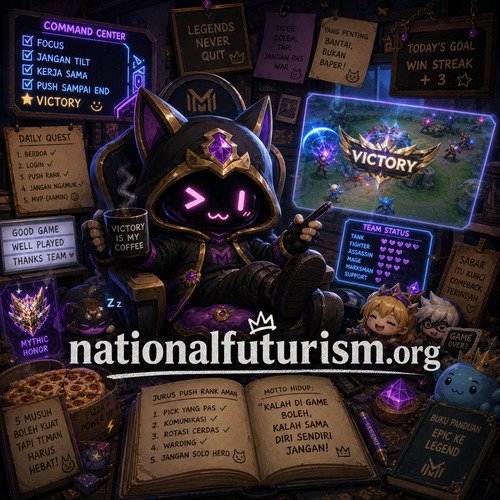
nationalfuturism.org – Mobile Legends: Bang Bang is a team-based multiplayer online battle arena game where two teams compete to destroy the opposing base while defending their own. Although the basic objective sounds simple, effective gameplay requires players to understand much more than attacking enemy heroes. Players need to manage lanes, farm resources, choose appropriate equipment, watch the minimap, coordinate with teammates, and recognize when to fight or retreat. A strong performance usually comes from making several small decisions correctly throughout a match rather than relying on one spectacular play. For new players, learning the fundamentals is therefore more useful than immediately trying to master complicated mechanics or individual hero combinations.
The game also becomes more interesting as players begin to understand how different roles interact. A marksman may need protection during the early stages, a tank can create opportunities by initiating fights, a jungler often controls important neutral objectives, while a mage or assassin can influence fights through burst damage and positioning. Because each role contributes differently, players should not approach every match with the same mindset. The right decision depends on the hero being used, the current state of the map, the position of allies and enemies, and the amount of gold and experience available. Learning how these elements connect provides a foundation for playing Mobile Legends more consistently and understanding why certain decisions work better than others.
Understanding the Core Gameplay of Mobile Legends
The first step toward playing Mobile Legends effectively is becoming familiar with the battlefield. The map is divided into three main lanes, a jungle area, defensive structures, and important neutral-objective locations. Each lane serves a different strategic purpose, and the flow of the match changes continuously as towers fall and players rotate around the battlefield. New players often concentrate almost entirely on the hero directly in front of them, but experienced gameplay requires attention to the wider map. Looking at the minimap regularly can reveal missing opponents, approaching teammates, vulnerable lanes, or opportunities to secure an objective. This information allows players to make decisions before a fight actually begins.
During the laning phase, players generally focus on collecting gold and experience from minions while attempting to maintain a safe position. Last-hitting is useful because resources are limited, and falling behind in gold can make later engagements difficult. However, farming should not become an excuse to ignore the rest of the team. If an enemy disappears from a lane, a quick warning can prevent an ally from walking into an ambush. Similarly, if several opponents appear on the opposite side of the map, a player may have an opportunity to clear a wave, damage a tower, or rotate toward another objective. Understanding these relationships gradually turns the map from a collection of lanes into a constantly changing source of information.
Choosing a Role and Understanding Its Responsibilities
Mobile Legends provides different hero roles, and learning what each role contributes makes team play considerably easier. Tanks and fighters can often create space or absorb pressure, while marksmen generally become more influential when they acquire enough items to deal sustained damage. Mages frequently provide magical damage, crowd control, or area pressure, whereas assassins are often used to punish vulnerable targets. Supports can assist teammates through healing, shields, crowd control, vision-related advantages, or other utility depending on the hero. The jungle position adds another layer because the player must efficiently clear jungle resources while monitoring lanes and neutral objectives.
A common beginner mistake is choosing a role based only on which hero appears powerful. Instead, players should consider whether they understand the role’s responsibilities. A marksman who constantly walks ahead of the frontline may be eliminated before contributing meaningful damage. A tank that refuses to protect vulnerable teammates can leave the team’s main damage source exposed. A jungler who spends too much time chasing kills may fall behind in farming and objective control. These situations demonstrate that hero strength alone does not determine performance. Knowing when to farm, rotate, defend, initiate, or disengage is equally important. Players who understand their responsibilities can also communicate more effectively because their actions become easier for teammates to predict.
Managing Gold, Experience, and Equipment
Gold and experience are central resources in Mobile Legends because they determine how quickly a hero gains levels and purchases equipment. A player who consistently collects resources can obtain important power spikes earlier, which may influence the outcome of subsequent fights. This makes efficient farming an important part of gameplay even when there is no immediate battle happening. Players should avoid unnecessary wandering because time spent moving without accomplishing anything can mean missed minions, jungle resources, or opportunities to assist teammates.
Equipment choices should also reflect the current match rather than follow a rigid pattern every game. Recommended builds can provide a useful starting point, particularly for beginners, but players should gradually learn why certain items are selected. Defensive equipment may become valuable when facing heavy burst damage, while offensive options can be prioritized when a hero needs additional damage to threaten opponents. Situational decisions are particularly important during longer matches because the enemy composition can change the value of different attributes. Learning to recognize these situations helps players become less dependent on predetermined builds and more capable of adapting to the actual conditions of a match.
Improving Decision-Making, Teamfights, and Map Control
One of the most important skills in Mobile Legends is recognizing that not every visible enemy should be attacked. Players sometimes enter fights simply because an opponent appears nearby, without considering health, cooldowns, positioning, or numerical advantage. A better approach is to evaluate the situation before committing. If an ally is far away, an important ultimate is unavailable, or multiple enemies are missing from the minimap, an aggressive move may carry significant risk. Conversely, if opponents have already used key abilities and several teammates are nearby, an engagement may become more favorable.
Retreating is not necessarily a sign of poor play. Preserving a hero’s life can protect accumulated gold, maintain defensive coverage, and prevent the enemy from gaining momentum. A player who survives an unfavorable encounter can return to the battlefield and continue farming, whereas an unnecessary death may give opponents resources and map control. This is especially important near major objectives and late in the match, when a single mistake can create enough time for the opposing team to destroy important structures. Good decision-making therefore involves understanding both aggression and restraint. The strongest players are not constantly fighting; they are choosing situations in which their actions have a meaningful chance of producing a useful result.
Using the Minimap and Rotating Efficiently
Map awareness connects almost every aspect of Mobile Legends gameplay. The minimap provides information about enemy locations, minion waves, towers, and the general distribution of both teams. Checking it frequently allows players to anticipate threats rather than react after the danger has already appeared. For example, if an enemy jungler is seen near one side of the map, teammates on the opposite side can temporarily adjust their positioning. If several opponents disappear at the same time, players can become more cautious because a coordinated rotation or ambush may be developing.
Rotations should also have a purpose. Moving from one lane to another simply because teammates are fighting can sometimes create more problems than it solves. Before rotating, players should consider whether the movement can secure a kill, protect a teammate, defend a structure, establish control around an objective, or create pressure somewhere else. A rotation that accomplishes nothing may result in lost farm and experience. On the other hand, a well-timed rotation can turn a small advantage into pressure across multiple areas of the map. This is why macro gameplay becomes increasingly important as players improve. Mechanics determine what a hero can do, but map awareness determines where and when those abilities should be used.
Executing Teamfights With Better Positioning
Teamfights are often decided before the first major ability is cast because positioning determines who can safely deal damage and who becomes vulnerable. Players should understand their role in the engagement rather than immediately attacking the closest target. Frontline heroes may need to create space or disrupt the enemy formation, while backline damage dealers generally want to remain at a safer distance. Assassins may wait for an opportunity to reach vulnerable targets after defensive abilities have been used. Supports and control-oriented heroes can focus on protecting allies or restricting enemy movement.
Target selection is another important consideration. Attacking the enemy tank simply because that hero is closest may not always be the most effective choice. In some situations, eliminating a vulnerable damage dealer can dramatically reduce the opposing team’s ability to fight. However, chasing a low-health target too far can also expose a player to additional enemies. Good teamfighting therefore involves balancing damage output with survival and awareness. Players should monitor enemy cooldowns, maintain appropriate spacing, and recognize when an engagement has already achieved its objective. Sometimes securing one elimination and immediately retreating is more valuable than pursuing several kills and losing multiple teammates in the process.
Practicing Mechanics Without Ignoring Fundamentals
Mechanical skill matters in Mobile Legends, particularly when using heroes with demanding movement patterns, precise abilities, or complicated combinations. Players can improve mechanics through repeated practice, learning ability ranges, understanding cooldowns, and becoming comfortable with movement during combat. However, mechanical execution should support decision-making rather than replace it. A player may execute a combination perfectly but still lose an engagement because the fight was entered at the wrong time or against too many opponents.
A useful practice method is to focus on one skill at a time. Players can first become comfortable with basic movement and ability usage, then learn common combinations, and finally practice those mechanics under realistic match conditions. Reviewing mistakes afterward can reveal whether a failed play came from execution or from an incorrect decision. This distinction is valuable because mechanical errors require different solutions from strategic errors. If an ability repeatedly misses because of poor positioning, practicing the combo alone may not solve the problem. Understanding the reason behind a mistake makes practice more efficient and encourages steady improvement.
Communicating and Playing Around Teammates
Mobile Legends is fundamentally a team game, which means communication can have a significant impact on the match. Players do not necessarily need lengthy conversations to coordinate effectively. Simple signals about missing enemies, objectives, retreats, or intended attacks can provide useful information. The purpose of communication is to make the team’s actions more coordinated, not to create unnecessary pressure between players.
Playing around teammates also means recognizing which heroes currently provide the greatest opportunity. If one teammate has a strong ultimate available, nearby players can position themselves to support a potential engagement. If another teammate is weak or underfarmed, the team may need to protect that player while allowing them additional time to recover. These adjustments require flexibility because the ideal plan at the beginning of a match may no longer apply several minutes later. Team composition, item progression, destroyed towers, and player positioning continuously alter the strategic situation. Players who adapt rather than rigidly following one plan can respond more effectively to these changes.
Reviewing Mistakes and Building Consistency
Improvement in Mobile Legends becomes much easier when players treat every match as a source of information. Instead of judging a game solely by whether the team won or lost, players can examine specific decisions. Did they die while pushing too far without vision? Did they miss an objective because they rotated late? Did they spend too much time chasing an enemy? Did they enter a teamfight without their main defensive ability? Questions like these identify patterns that can be corrected in future matches.
Consistency generally develops from reducing unnecessary mistakes rather than attempting spectacular plays every game. A player who farms efficiently, checks the minimap, protects important teammates, rotates with a clear purpose, and avoids reckless deaths can contribute significantly even without producing an impressive kill count. Over time, these habits become automatic. The player begins to recognize dangerous situations earlier, understands when a lane can be pushed safely, and becomes more comfortable adapting equipment and positioning. This gradual improvement is one of the most rewarding aspects of Mobile Legends because the game begins to feel less random as players understand the relationship between their decisions and the results that follow.
Conclusion How to Play Mobile Legends: A Practical Guide to Better Gameplay, Teamwork, and Map Awareness
Learning how to play Mobile Legends effectively involves much more than mastering a favorite hero. The game rewards players who understand the map, manage resources, recognize their role, communicate with teammates, and make informed decisions about when to fight or retreat. Mechanics remain important, but they become significantly more useful when combined with awareness and strategic thinking. A player who understands where to stand, when to rotate, which objective deserves attention, and how to respond to enemy movements can often contribute more consistently than someone who focuses exclusively on individual kills.
The best way to develop these abilities is through deliberate practice and reflection. Learn the fundamentals first, become comfortable with a few heroes, observe the minimap regularly, and pay attention to why engagements succeed or fail. As these habits become natural, more advanced concepts such as macro gameplay, objective timing, wave management, and coordinated teamfights become easier to understand. Mobile Legends is ultimately a game of continuous decisions, and improving those decisions from one match to the next is what turns basic familiarity into confident gameplay.