
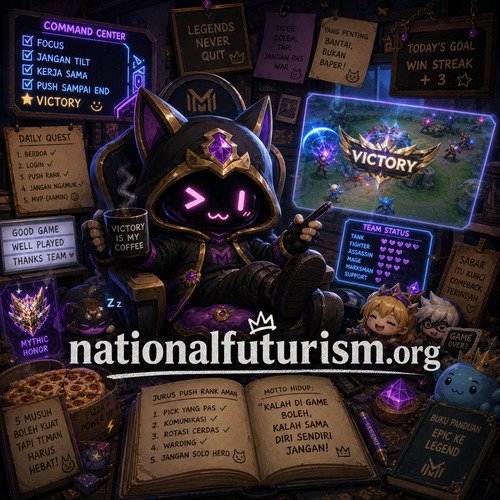
nationalfuturism.org – Mobile Legends: Bang Bang is one of the most competitive and exciting multiplayer games available on mobile devices today. Since its release, the game has attracted millions of players from around the globe, creating a vibrant community that ranges from casual players to professional esports competitors. The combination of fast-paced matches, strategic depth, and teamwork has helped Mobile Legends maintain its popularity across multiple generations of gamers.
At first glance, Mobile Legends appears straightforward. Two teams of five players enter the battlefield with the goal of destroying the enemy’s base. However, beneath this simple objective lies a highly complex game that rewards planning, adaptability, communication, and game knowledge. Every decision made throughout a match can influence the final outcome, whether that decision involves farming a minion wave, rotating to another lane, contesting an objective, or engaging in a team fight.
One reason Mobile Legends remains appealing after thousands of matches is its unpredictability. Every game develops differently depending on hero selections, player decisions, objective control, and countless other variables. This constant variation keeps the experience fresh and challenges players to adapt to new situations.
Many players become trapped in the mindset that individual performance is the only factor that matters. While personal skill is certainly important, Mobile Legends is ultimately a team-oriented game. Success depends not only on what a player can accomplish individually but also on how effectively they contribute to the overall strategy of their team.
The strongest competitors understand that improvement is a continuous process. They do not simply play the game; they study it. They learn from mistakes, analyze their decisions, and constantly search for ways to become more effective. This dedication to learning often separates average players from those who consistently reach higher ranks.
Understanding Mobile Legends at a deeper level allows players to make smarter decisions, contribute more effectively to their teams, and enjoy a more rewarding experience. By focusing on both individual development and team success, players can dramatically improve their performance over time.
Understanding the Different Phases of a Match
Every Mobile Legends match can be divided into several stages, each requiring different priorities and strategic approaches. Recognizing these phases helps players make better decisions throughout the game.
The early game begins the moment heroes enter the battlefield and continues through the first several minutes of the match.
During this phase, resource collection is the primary objective. Players focus on gathering gold and experience through minion waves, jungle camps, and objectives. Efficient farming creates the foundation necessary for future success.
Different roles have different priorities during the early game. Marksmen typically concentrate on accumulating gold in their designated lane. Fighters focus on gaining experience and controlling side lanes. Mages clear waves quickly and assist teammates through rotations. Junglers optimize their farming routes while preparing to secure objectives.
One common mistake among inexperienced players is pursuing unnecessary fights. Aggressive engagements may appear exciting, but they often result in wasted time or prevent players from collecting valuable resources.
Successful players understand that patience is often rewarded. They focus on building advantages gradually rather than forcing risky situations. By maintaining discipline during the early game, they create stronger opportunities later in the match.
Transitioning Into the Mid Game
As players acquire items and levels, the match enters the mid-game phase.
During this stage, objectives become increasingly important. Teams begin contesting Turtle more aggressively, rotating more frequently, and looking for opportunities to destroy outer turrets.
The mid game is where map control starts to influence the outcome significantly. Teams that successfully secure objectives and apply pressure across multiple lanes often establish advantages that become difficult to overcome.
Communication becomes particularly valuable during this phase. Coordinated rotations and objective contests require players to share information effectively and respond quickly to changing situations.
Strong teams use the mid game to expand their influence across the map. They create pressure in multiple locations, forcing opponents to make difficult decisions and creating opportunities for strategic gains.
Players who understand how to navigate the mid game effectively often place their teams in favorable positions heading into the later stages of the match.
Managing Late-Game Situations
The late game is frequently the most decisive phase because mistakes become increasingly costly.
At this stage, most heroes have completed several important items, making team fights more impactful and objectives more valuable. A single successful engagement can determine the outcome of the entire match.
Positioning becomes extremely important during late-game encounters. Damage dealers must remain protected while continuing to contribute offensively. Tanks and fighters must create space without exposing themselves unnecessarily.
Decision-making also becomes more critical. Teams must evaluate whether to contest objectives, push lanes, defend structures, or initiate fights. Poor decisions during the late game often result in immediate consequences.
Experienced players remain disciplined even when matches become tense. They understand that patience and careful execution often produce better results than reckless aggression.
Building Strong Team Coordination
Although individual mechanics can influence specific moments, teamwork remains one of the most important factors in Mobile Legends.
Communication allows teams to function as a unified group rather than five independent players.
Even simple information can significantly improve team performance. Informing teammates about missing enemies, objective intentions, or incoming threats helps everyone make better decisions.
The in-game ping system provides a fast and effective way to communicate without interrupting gameplay. Learning how to use pings appropriately improves coordination and reduces confusion.
Effective communication also encourages cooperation. Teams that share information consistently tend to react more quickly and capitalize on opportunities more efficiently.
Players who communicate clearly often contribute more value than those who focus exclusively on their individual performance.
Understanding the Importance of Role Synergy
Every hero fulfills a specific purpose within a team composition.
Tanks provide protection and initiation. Fighters create pressure and disrupt enemy formations. Marksmen deliver sustained damage. Mages contribute burst damage and crowd control. Assassins eliminate priority targets.
Understanding how these roles interact improves overall team effectiveness. Successful teams coordinate their abilities and positioning to maximize their collective strengths.
For example, a tank’s initiation creates opportunities for damage dealers to attack safely. Likewise, proper positioning by marksmen allows frontline heroes to operate more effectively.
Role synergy transforms individual actions into coordinated strategies capable of overwhelming opponents.
Learning to Trust Teammates
Many players attempt to solve every problem alone. While individual initiative can be valuable, excessive independence often creates difficulties.
Trusting teammates allows responsibilities to be distributed more effectively. Instead of attempting to perform every task personally, players can focus on their specific roles and contribute more efficiently.
This trust does not require perfect coordination. Rather, it involves understanding that teamwork generally produces better outcomes than isolated actions.
Players who embrace cooperation often find that matches become more manageable and enjoyable.
As players gain experience, they begin focusing on concepts that support long-term development and competitive growth.
Developing Superior Decision-Making
Decision-making influences nearly every aspect of Mobile Legends.
Players constantly choose between farming and fighting, defending and attacking, rotating and staying in lane. These decisions accumulate throughout the match and significantly affect outcomes.
Strong decision-making requires evaluating risks and rewards. Not every opportunity should be pursued. Sometimes the safest option provides the greatest long-term benefit.
Experienced competitors gather information before acting. They consider enemy positions, ally status, objective timers, and resource advantages before committing to a course of action.
Improving decision-making often produces larger benefits than improving mechanics alone.
Understanding Adaptability
Adaptability is one of the defining characteristics of high-level play.
Different opponents, team compositions, and match conditions require different approaches. Players who rely on a single strategy often struggle when circumstances change.
Adaptable competitors adjust their item builds, positioning, rotations, and priorities according to the situation. They remain flexible and willing to modify their plans as new information becomes available.
This flexibility allows them to remain effective across a wide variety of scenarios.
Building Long-Term Consistency
Consistency separates reliable players from unpredictable ones.
Many players perform exceptionally well occasionally but struggle to maintain that level of performance over time. Consistency comes from strong habits and disciplined execution.
Regular minimap checks, efficient farming, objective prioritization, and effective communication all contribute to reliable performance.
Consistent players focus on executing fundamentals correctly rather than pursuing flashy plays. As a result, they often achieve better long-term outcomes.
Embracing Continuous Learning
The competitive landscape of Mobile Legends changes constantly.
New heroes, balance updates, and evolving strategies ensure that there is always something new to learn. Players who remain curious and open-minded continue improving long after others plateau.
Watching professional matches, reviewing gameplay, and studying successful strategies can provide valuable insights. Even small improvements accumulate over time and produce significant results.
Continuous learning ensures that players remain competitive regardless of how the game evolves.
Conclusion Mobile Legends: How to Become a Smarter Player Through Strategy, Communication, and Consistent Improvement
Mobile Legends: Bang Bang is a game that rewards much more than mechanical skill. While fast reactions and accurate execution remain important, true success depends on understanding strategy, teamwork, communication, and decision-making.
Players who master the different phases of a match, coordinate effectively with teammates, manage resources efficiently, and adapt to changing circumstances gain a substantial advantage over their opponents. These skills create a strong foundation that supports consistent improvement and competitive success.
The path toward mastery is not defined by shortcuts. It is built through practice, reflection, discipline, and a willingness to learn. Every match provides opportunities to refine existing skills and develop new ones.
Whether the goal is climbing the ranked ladder, becoming a stronger teammate, or simply enjoying the game at a higher level, success comes from embracing continuous improvement. By focusing on both personal growth and team success, players can unlock their full potential and achieve lasting success in the dynamic and ever-evolving world of Mobile Legends.