
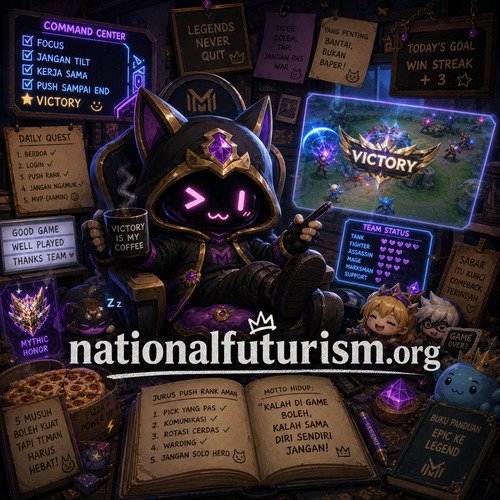
nationalfuturism.org – Mobile Legends: Bang Bang is not a game that rewards random fights or mechanical highlight plays alone. Beneath its fast-paced combat lies a structured system of tempo control, map pressure, and decision layering. Every hero contributes to a larger strategic engine, and every action either strengthens or weakens a team’s control over that engine. Winning consistently comes from understanding how to guide the flow of the match rather than reacting to it.
Hero Roles and the Structural Mechanics of Team Composition
Each hero in Mobile Legends exists within a predefined role system that determines how they interact with fights, objectives, and map control. These roles are not isolated identities but interconnected systems that shape the entire match structure from early game to late game.
Tanks are the backbone of team structure because they define how space is taken and how fights begin. Their impact is often subtle but extremely powerful, as their positioning alone can force enemies to reposition, hesitate, or abandon objectives entirely.
In team fights, tanks are responsible for initiating at moments of maximum advantage. A proper initiation is not about speed but precision—catching enemies when cooldowns are unavailable or when positioning is broken. A well-executed engage can instantly shift the outcome of a fight before damage even begins.
Outside of combat, tanks function as vision leaders and rotation protectors. They enter fogged areas first, check bushes, and secure safe paths for teammates. This reduces uncertainty and allows the team to move with confidence. Without this role properly executed, even strong teams lose map control due to hesitation.
Assassins and the Economy of Instant Impact
Assassins operate under a principle of high-risk, high-reward timing windows. Their goal is not sustained fighting but instant elimination of key targets. Every engagement they take is calculated around opportunity rather than constant presence.
The effectiveness of assassins depends heavily on patience and awareness. They wait for critical conditions such as enemy mispositioning, cooldown usage, or isolation before committing. Once the window appears, execution must be immediate and decisive.
However, assassins are extremely punishable if mistimed. A single incorrect entry can lead to instant elimination, making their role heavily dependent on prediction and map awareness rather than raw mechanical speed alone.
Mages and Fighters as Adaptive Pressure Systems
Mages and fighters serve as flexible pressure units that adjust their function based on game state and team needs. They are not fixed-role characters but dynamic tools that shape both fights and map control.
Mages specialize in zoning and space denial. Their abilities influence movement patterns and restrict access to key areas, especially around objectives like Turtle and Lord. This allows teams to control fight locations without direct engagement.
Fighters provide sustained lane pressure and mid-game durability. Their ability to switch between split pushing and team fighting makes them essential for map-wide pressure distribution. This forces opponents into constant reactive movement instead of controlled strategy execution.
Macro Strategy and the Architecture of Map Control Flow
Macro strategy is the system that determines how teams move across the map and how advantages are converted into winning conditions. It is the difference between temporary success and consistent victory.
The early game is defined by structured efficiency and resource balance. Each hero must remain in their assigned lane to ensure proper gold and experience distribution. Breaking this structure too early often leads to uneven scaling and weak mid-game transitions.
Wave control is the foundation of early macro play. Efficient wave clearing allows safe rotations without sacrificing farm or map pressure. Mid-laners often act as connectors between lanes, enabling fast transitions and side lane influence.
However, early game success is not about constant aggression. Knowing when to stay still is just as important as knowing when to rotate. Unnecessary movement often results in lost turrets or wasted tempo, giving the enemy structural advantage.
Mid Game Conversion and Objective Pressure Expansion
The mid game is where structure begins to translate into dominance. Objectives such as Turtle, outer turrets, and jungle control define how much of the map a team controls.
Coordination becomes essential during this phase. Teams must group to secure numerical advantage in fights. Arriving late or splitting incorrectly often results in lost objectives and momentum swings.
Pressure is also created through lane manipulation. While one objective is being contested, another lane is pushed to force enemy response. This creates decision pressure, splitting attention and weakening defensive stability.
Vision Control and Information Superiority Systems
Vision is one of the most important strategic tools because it removes uncertainty from decision-making. With information, teams act confidently; without it, every movement becomes risky.
Vision is established through map presence, bush control, and coordinated rotations. Tanks typically lead this process, but all players contribute by maintaining awareness and avoiding blind movement into unknown areas.
Teams with superior vision control dictate the tempo of the match. They choose when fights happen, where they occur, and how they unfold, creating a stable path toward victory.
At high-level play, mechanical execution alone is not enough. The real separation comes from adaptation—the ability to adjust strategy, positioning, and itemization based on evolving conditions.
Mechanical Execution with Strategic Alignment
Mechanical skill enables execution under pressure, but without strategic alignment it loses value. Every action must serve a purpose within the broader game plan.
Each hero has optimal execution patterns, but success depends on timing and target selection. Misusing abilities on low-value targets or at incorrect moments reduces overall impact significantly.
Positioning plays a critical role in survival and output. Proper spacing allows damage while minimizing exposure. Small positional decisions often determine whether a player survives late-game burst situations.
Adaptive Itemization and Counter Strategy Prediction
Itemization is dynamic and must evolve based on enemy composition and match progression. Static builds reduce flexibility and often lead to inefficiency.
Defensive items are required against burst-heavy compositions, while penetration items are essential against tank-heavy teams. Hybrid builds allow balance between survivability and damage output depending on match conditions.
Counter strategy includes prediction rather than reaction. Understanding enemy scaling patterns allows players to adapt before fights begin, creating advantages proactively instead of reactively.
Endgame Discipline and Psychological Stability Control
The late game is the most decisive phase of Mobile Legends. One mistake can end the match due to high damage scaling and long respawn timers. Because of this, discipline becomes more valuable than aggression.
Successful teams prioritize patience and structured engagement. They avoid unnecessary fights and wait for clear advantages such as mispositioning or cooldown disadvantages.
Psychological stability is equally important. Calm players make better decisions under pressure, while panic leads to overextension and communication breakdowns. Recognizing enemy hesitation often creates winning opportunities without requiring mechanical superiority.
Conclusion Mobile Legends Strategic Blueprint: Heroes, Tempo Manipulation, and Winning Through Structure
Mobile Legends is ultimately a structured system of timing control, adaptive intelligence, and coordinated decision-making. Heroes define capabilities, but strategy defines outcomes. Understanding roles, managing map pressure, and executing disciplined decisions under uncertainty form the foundation of consistent victory.
True mastery comes from combining mechanics with strategic awareness and mental discipline. Players who can read the battlefield, adapt to shifting conditions, and execute with precision will always hold an advantage. In the end, success is not about individual moments, but about how every decision contributes to the larger strategic rhythm that governs the entire match.